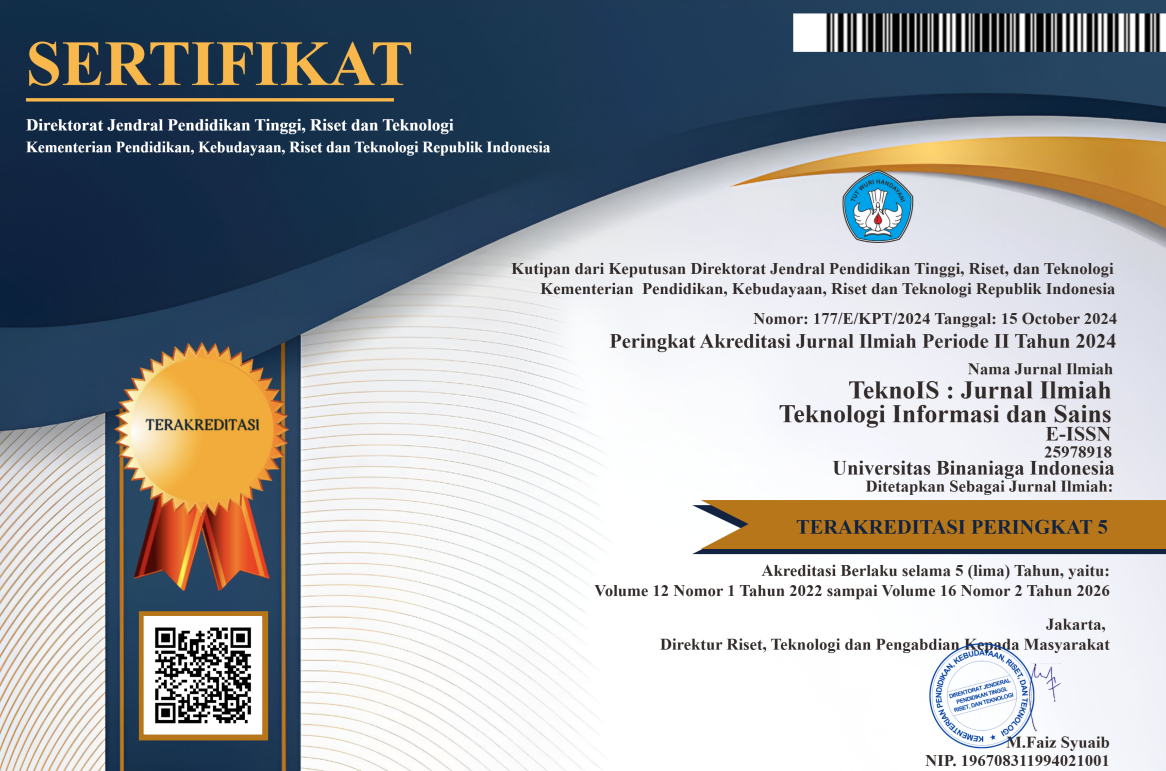
TeknoIS Journal has been accredited with SINTA 5 based on the decree of the Kementerian Pendidikan, Kebudayaan, Riset dan Teknologi of the Republic of Indonesia Number 177/E/KPT/2024
TeknoIS requires authors, editors, and reviewers to disclose any financial, professional, institutional, personal, or other relationships that could reasonably be perceived to influence their judgment or the interpretation of research findings.
A conflict of interest does not necessarily indicate inappropriate conduct. However, failure to disclose a relevant conflict may compromise transparency and trust in the publication process.
Authors
Authors must disclose relevant competing interests when submitting a manuscript. These may include employment, consultancy, financial support, research funding, ownership of shares, patents, personal relationships, or institutional affiliations that could influence the research or its interpretation.
If no relevant conflict exists, authors should include the following statement in their manuscript:
"The authors declare that they have no competing interests."
Editors
Editors must declare relevant conflicts and must not make editorial decisions on manuscripts where their impartiality could reasonably be questioned. Such manuscripts should be reassigned to an independent editor.
Reviewers
Reviewers must disclose any actual or potential conflicts of interest before accepting a review assignment. Reviewers should decline assignments when a conflict could compromise their objectivity.
All disclosures will be considered during editorial assessment. The journal may request additional information, appoint an independent editor or reviewer, or take other appropriate measures to preserve the integrity of the review process.
Conflict-of-interest information will be handled transparently and disclosed in published articles when appropriate.
TeknoIS Journal has been accredited with SINTA 5 based on the decree of the Kementerian Pendidikan, Kebudayaan, Riset dan Teknologi of the Republic of Indonesia Number 177/E/KPT/2024