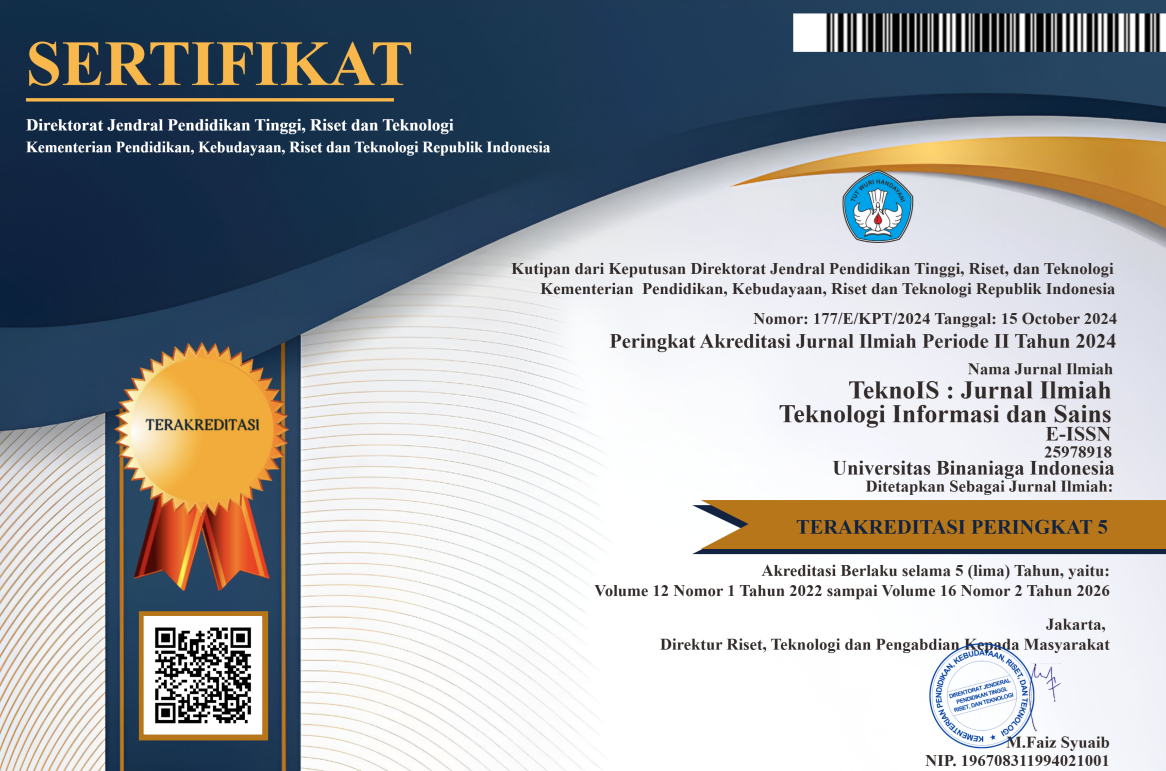
TeknoIS Journal has been accredited with SINTA 5 based on the decree of the Kementerian Pendidikan, Kebudayaan, Riset dan Teknologi of the Republic of Indonesia Number 177/E/KPT/2024
TeknoIS: Jurnal Ilmiah Teknologi Informasi dan Sains recognizes that Artificial Intelligence (AI), including Generative Artificial Intelligence (Generative AI), can support scholarly research, academic writing, data analysis, software development, and scientific communication.
To maintain academic integrity, transparency, originality, confidentiality, and accountability in scholarly publishing, TeknoIS establishes this Artificial Intelligence (AI) Policy for authors, editors, reviewers, and other parties involved in the publication process.
This policy is informed by the publication ethics principles of the Committee on Publication Ethics (COPE), the generative AI policies of Elsevier, the recommendations of the World Association of Medical Editors (WAME), and the International Committee of Medical Journal Editors (ICMJE) recommendations on AI-assisted technologies in scholarly publishing.
The use of AI is not automatically considered research misconduct. However, all AI-assisted activities must be conducted responsibly, with appropriate human oversight and disclosure whenever required by this policy.
This policy applies to all individuals involved in the editorial and publication processes of TeknoIS, including:
Authors and co-authors submitting manuscripts to TeknoIS.
Editors, including the Editor-in-Chief, associate editors, and section editors.
Peer reviewers and other appointed evaluators.
Journal administrators and other personnel involved in manuscript processing and publication.
This policy covers the use of AI in manuscript preparation, literature review, data collection and analysis, software development, scientific visualization, image generation or manipulation, peer review, editorial assessment, and other activities related to scholarly publication.
TeknoIS establishes the following principles for the responsible use of AI:
AI tools cannot replace the responsibility of human authors, reviewers, or editors. Individuals remain accountable for the accuracy, integrity, originality, and validity of their contributions and decisions.
Substantive use of Generative AI must be disclosed in accordance with this policy. Disclosures must identify the tool used, its purpose, and the relevant extent of its contribution.
AI must not be used to fabricate or falsify research data, manipulate scientific evidence, conceal plagiarism, misrepresent authorship, or produce misleading research findings.
All AI-generated or AI-assisted content must be critically reviewed and verified by a responsible human before submission or publication.
Confidential manuscripts, unpublished research, personal information, and restricted datasets must not be disclosed to external AI services without appropriate authorization, adequate safeguards, and compliance with applicable confidentiality and data protection requirements.
AI must not be used in ways that compromise impartial peer review, introduce unjustified discrimination, or undermine fair editorial decision-making.
Authors may use AI tools responsibly to support the following activities:
Correcting spelling, grammar, punctuation, and language errors.
Improving language clarity, readability, and translation.
Developing preliminary outlines and organizing research materials.
Assisting with literature discovery, screening, categorization, or synthesis, provided that the original sources are independently verified.
Supporting software development, code debugging, technical documentation, and computational experimentation.
Assisting with data processing, statistical analysis, machine learning, predictive modeling, and other computational research activities.
Supporting the preparation of tables, charts, illustrations, and other research materials, provided that their accuracy, originality, and appropriate attribution are ensured.
The use of AI does not exempt authors from verifying the correctness, relevance, validity, and suitability of the generated output.
Authors must disclose the use of Generative AI or AI-assisted tools when such tools make a substantive contribution to manuscript preparation or research reporting, including when they are used to:
Generate new manuscript text or substantive portions of a manuscript.
Substantively restructure, rewrite, or reorganize arguments or paragraphs.
Generate, reconstruct, or materially modify figures, illustrations, tables, or other materials that form part of the scientific contribution.
Generate or materially modify code, data, analytical outputs, or interpretations that affect the research findings.
Conduct AI-assisted literature synthesis that materially informs the research arguments or conclusions.
Perform research procedures using AI where the use is relevant to the methodology, reproducibility, or interpretation of the findings.
Routine spelling, grammar, and punctuation checks that do not substantively change the content do not require a separate AI declaration.
Where AI is used as part of the research process rather than merely for manuscript preparation, authors must describe its use in the Methods section, including the tool or model, its purpose, the relevant procedures, and sufficient technical information to support evaluation or reproducibility.
When disclosure is required under Section 4.2, authors must include an AI declaration in the submitted manuscript, preferably in a dedicated section before the References.
Authors may use the following statement and adapt it to their actual use:
Declaration of Generative AI and AI-Assisted Technologies
"During the preparation of this manuscript, the author(s) used [name of AI tool or service] for [specific purpose of use]. The author(s) critically reviewed, verified, and edited the AI-assisted output as necessary and take full responsibility for the accuracy, integrity, originality, and final content of the manuscript."
Authors must ensure that this declaration accurately reflects the actual use of AI. The declaration must not be used to justify unverified content or undisclosed research procedures.
When AI is used in research design, data collection, data analysis, software development, image generation, or other methodological activities, the relevant technical details must also be reported in the Methods section.
If no AI use requiring disclosure has occurred, authors may provide the following statement when requested by the journal:
"The author(s) did not use Generative AI or AI-assisted technologies in a manner requiring disclosure under the TeknoIS AI Policy."
Authors must not:
List an AI tool, chatbot, or AI system as an author or co-author.
Present AI-generated references, citations, DOIs, quotations, or factual claims as verified information without checking the original sources.
Fabricate research data, experimental results, participants, observations, or scientific evidence using AI and present them as genuine research findings.
Manipulate scientific images, measurements, or visualizations in a misleading manner.
Use AI to conceal plagiarism, duplicate publication, or unauthorized use of third-party intellectual property.
Submit uncritically generated AI output as a verified scientific contribution.
Upload personal data, confidential research data, or restricted materials to AI services without appropriate authorization and safeguards.
All authors remain fully responsible for the submitted manuscript, including AI-assisted text, references, datasets, code, figures, interpretations, and conclusions.
Authors must ensure that any AI-assisted content complies with applicable copyright, licensing, privacy, research ethics, and intellectual property requirements.
Peer reviewers are responsible for providing independent, objective, confidential, and constructive assessments of submitted manuscripts.
Accordingly:
Reviewers must not upload submitted manuscripts, in whole or in part, to external Generative AI services. This restriction also applies to supplementary files, unpublished datasets, confidential author information, and editorial communications.
Reviewers must not delegate their scientific evaluation or publication recommendations to AI systems.
Reviewers must independently assess the originality, methodological soundness, validity of findings, relevance, and scientific contribution of each manuscript.
Reviewers may use non-generative technical tools for permitted checking activities, provided that confidentiality is maintained.
Any proposed use of AI for preparing review reports must be consistent with the journal's confidentiality requirements and explicitly authorized by the journal where applicable.
Where AI-assisted tools are authorized for limited review-related tasks, reviewers must disclose such use to the editor and remain responsible for the accuracy, impartiality, and appropriateness of the final review.
Reviewers must not use AI-generated evaluations as a substitute for their own professional judgment.
Reviewers must treat all manuscripts and related materials as confidential communications and must comply with the journal's peer-review procedures.
Editors are responsible for ensuring the integrity, confidentiality, fairness, and independence of the editorial process.
Editors must comply with the following requirements:
Editors must not upload unpublished manuscripts, reviewer reports, confidential correspondence, or other restricted editorial materials to external Generative AI services.
Editors must not delegate decisions concerning acceptance, rejection, revision, novelty, methodological quality, or scientific validity to AI systems.
AI may be used for limited administrative or technical assistance only when confidentiality, data protection, and the journal's internal requirements are satisfied.
Any AI system used for editorial support must be subject to appropriate human oversight and must not compromise confidential information or independent editorial judgment.
Final editorial decisions must be made by authorized human editors based on the scientific merit of the manuscript, peer-review reports, and relevant editorial considerations.
Editors must assess suspected AI-related misconduct fairly, proportionately, and in accordance with the journal's publication ethics procedures.
If the journal uses AI for copyediting, production, or other publication-related purposes, the journal should provide appropriate transparency about such use.
AI may be used as a research method or computational instrument in information technology and scientific research. However, its use must be documented and scientifically justified where relevant.
The following requirements apply:
Synthetic data, AI-generated images, and simulated results must not be presented as real-world observations or experimental evidence without clear and appropriate disclosure.
AI-generated or AI-modified figures must be disclosed when their use materially affects the evidence, interpretation, or scientific contribution of the article.
Image manipulation that misleadingly adds, removes, or alters scientific evidence is prohibited.
The use of AI in machine learning, deep learning, computer vision, predictive analytics, software development, or computational experimentation must be described in the Methods section when relevant to the research procedure, reproducibility, or interpretation of findings.
Authors should report relevant information about the AI model, tool, version, configuration, input data, procedures, and evaluation methods, as appropriate to the study.
Authors must ensure that AI-assisted research complies with applicable data protection requirements, research ethics approvals, copyright restrictions, licensing conditions, and intellectual property rights.
AI-generated references or summaries must not replace verification of the original scientific literature.
The use of AI as a research object, algorithm, or analytical method is distinct from the use of AI to prepare a manuscript. Researchers who develop or evaluate AI systems are not required to declare AI-assisted manuscript preparation solely because AI is the subject or method of their research. Nevertheless, the use of AI in the research methodology must be reported where required by this policy.
TeknoIS reserves the right to investigate suspected violations of this policy before or after publication.
The investigation may include:
Requesting clarification or additional information from the authors.
Verifying references, quotations, datasets, code, images, and reported results.
Reviewing relevant supporting materials or research records.
Examining the declared use of AI and its consistency with the submitted manuscript.
Consulting appropriate experts or following established publication ethics procedures where necessary.
AI-detection tools may be used as supplementary screening instruments, but their results must not be treated as conclusive proof of misconduct or as the sole basis for an adverse editorial decision.
Any determination of misconduct must be made through human assessment of the available evidence, the author's explanation, the context of AI use, and the applicable ethical standards.
Depending on the nature and severity of the violation, TeknoIS may take proportionate action, including:
Requesting clarification or additional disclosure.
Requiring correction or revision of the manuscript.
Suspending the editorial process pending investigation.
Rejecting the manuscript.
Correcting, retracting, or otherwise addressing a published article in accordance with applicable publication ethics procedures.
All cases will be handled fairly, consistently, and with due consideration of the relevant evidence and the rights of the parties involved.
This policy may be reviewed and updated periodically to reflect developments in AI technology, scholarly publishing standards, applicable laws, and recognized publication ethics practices.
By submitting a manuscript to TeknoIS, authors acknowledge that they have read and agree to comply with this policy. Reviewers and editors are also required to follow the provisions applicable to their respective roles.
The policy takes effect upon formal approval by the management of TeknoIS: Jurnal Ilmiah Teknologi Informasi dan Sains.
TeknoIS Journal has been accredited with SINTA 5 based on the decree of the Kementerian Pendidikan, Kebudayaan, Riset dan Teknologi of the Republic of Indonesia Number 177/E/KPT/2024